
For decades, networking was a discipline defined by hardware. Routers, switches, cables, and configurations the backbone of every connected business, managed by skilled engineers who spent hours troubleshooting outages, patching vulnerabilities, and manually optimising performance. It worked. But it didn’t scale. And as the demands on enterprise networks have grown exponentially driven by cloud, remote work, IoT, and now AI workloads the old model has started to crack.
Juniper Networks has been thinking about this problem for a long time. And the answer they’ve arrived at is both elegant and ambitious: what if the network could think for itself?
From Routing Pioneer to AI-Native Platform
Juniper was founded in 1996 with a single, clear mission: build a better router. At a time when the internet was growing faster than the infrastructure supporting it, Juniper’s engineers developed hardware and software that could handle the scale and complexity that existing solutions couldn’t. The company quickly became a trusted name in service provider and enterprise networking, known for performance, reliability, and a distinctly engineering-led culture.
But the networking landscape has changed beyond recognition since those early days. The rise of cloud computing, the explosion of wireless devices, the shift to distributed workforces, and now the emergence of AI as a core business function all of these have placed new and often conflicting demands on network infrastructure. Speed matters. Reliability matters. Security matters. And increasingly, so does the ability to manage all of it with fewer people and less manual effort.
Juniper’s response has been to build what it calls an AI-Native networking platform not AI bolted onto existing products, but a fundamental rethinking of how networks are designed, operated, and optimised from the ground up.
Marvis: The AI That Runs the Network
At the heart of Juniper’s AI strategy is Marvis, an AI-powered virtual network assistant that does something most network tools don’t: it explains itself. Traditional network monitoring tools generate alerts. Lots of them. An engineer receives a notification that something is wrong, and then has to diagnose the cause often spending hours correlating data across multiple systems before finding the root issue. Marvis takes a different approach. It doesn’t just flag problems; it identifies the cause, explains it in plain language, and in many cases resolves it automatically before users even notice anything is wrong.
This concept which Juniper calls Explainable AI is particularly significant in an enterprise context. IT teams aren’t just looking for answers; they need to understand and trust those answers, especially when changes to network configuration can affect business-critical operations. Marvis bridges the gap between AI capability and human oversight, giving network engineers the information they need to make confident decisions quickly. The result is measurable. Organisations using Marvis report significant reductions in mean time to resolution for network issues, fewer helpdesk tickets related to connectivity, and more proactive identification of problems before they impact users.
AIOps: Running IT at a Different Speed
Juniper’s broader AIOps (Artificial Intelligence for IT Operations) framework extends the intelligence of Marvis across the entire network stack wired, wireless, WAN, and data centre. The platform continuously collects telemetry data from across the network, applies machine learning to identify patterns and anomalies, and surfaces actionable insights to IT teams.
What makes this practically powerful is the scope. A modern enterprise network might span dozens of branch offices, thousands of wireless access points, multiple data centres, and a hybrid cloud environment. Managing all of this manually is not just inefficient’; it’s increasingly impossible. AIOps gives IT teams a unified view across the entire estate, with the intelligence to prioritise what matters and automate what doesn’t need human intervention. For businesses that have struggled with the growing complexity of their network infrastructure, this represents a genuine shift in how IT operations work from reactive firefighting to proactive management.
One of the most tangible expressions of Juniper’s AI-Native vision is in how it approaches campus and branch networking. The rollout of Wi-Fi 7 the latest generation of wireless technology, offering significantly higher speeds, lower latency, and better performance in dense environments is an opportunity to rethink not just the hardware, but the entire operational model for enterprise wireless.
Juniper’s approach combines Wi-Fi 7 access points with its cloud-native management platform, allowing organisations to deploy, monitor, and optimise wireless networks with a level of automation that simply wasn’t possible with previous generations. Marvis monitors wireless performance continuously, identifies interference issues, predicts capacity problems, and adjusts configurations dynamically all without requiring manual intervention from network engineers.
For large organisations universities, hospitals, retail chains, corporate campuses the implications are significant. Better performance for end users, lower operational overhead for IT, and the ability to support new applications and use cases that demand consistent, high-quality connectivity.
AI Data Centres: Building the Infrastructure for the AI Era

Perhaps the most forward-looking part of Juniper’s portfolio is its AI data centre networking solution. As enterprises invest in AI infrastructure GPU clusters for model training, inference servers, large-scale storage systems the network connecting all of these components becomes a critical bottleneck. The performance requirements are fundamentally different from traditional data centre workloads: high bandwidth, ultra-low latency, and near-perfect reliability are not optional.
Juniper’s data centre networking portfolio, built around high-performance switches supporting 400GbE and 800GbE connectivity, is designed specifically for these demanding environments. Combined with Apstra, Juniper’s data centre automation platform, organisations can design, deploy, and operate AI infrastructure networks with a level of automation and intent-based management that dramatically reduces the time and expertise required.
The Ops4AI Lab in Sunnyvale, California, takes this a step further giving enterprise customers a hands-on environment where they can test their own AI models on Juniper’s infrastructure before committing to a deployment. It’s a practical, no-nonsense approach that reflects Juniper’s engineering culture: show, don’t just tell.
Now Part of HPE: A Larger Stage for a Clear Vision
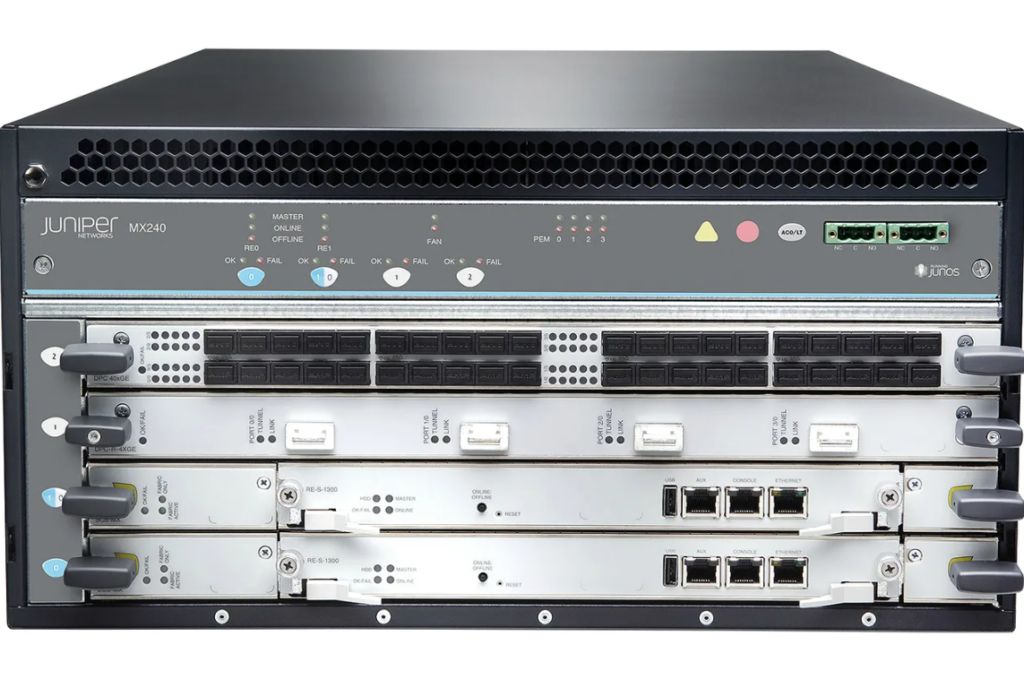
In 2024, Juniper Networks became part of Hewlett Packard Enterprise a move that significantly expands the reach and resources behind Juniper’s AI-Native networking vision. The combination brings together Juniper’s networking expertise and AI platform with HPE’s broader infrastructure portfolio and global enterprise relationships.
For customers, this means continuity of the Juniper platform and roadmap, combined with access to a wider set of integrated solutions. For the industry, it signals that the convergence of AI and networking is not a niche trend but a mainstream direction one that the largest players in enterprise technology are now firmly committed to. The network has always been critical infrastructure. But for most of its history, it has also been largely invisible noticed only when something goes wrong. Juniper Networks is building a future where the network is not just infrastructure but intelligence: a system that learns, adapts, and improves continuously, freeing IT teams to focus on what matters rather than maintaining what exists.
Whether that vision is fully realised will depend on execution, adoption, and the pace at which enterprises are willing to embrace AI-driven operations. But the direction is clear, the technology is maturing, and Juniper now backed by HPE is one of the most credible voices making the case for what enterprise networking can become.